
School Admissions: Step-by-Step Guide for Parents

Updated: June 28,2026
Every parent wants the same thing: a school where their child will genuinely thrive. But finding that school, navigating forms, timelines, and interviews, while managing a full-time job and family life, can feel like a full-time task in itself.
You are not alone. Across India, thousands of families begin their school admission journey each year feeling unsure about where to start, what documents to collect, which curriculum to choose, and how early is early enough.
This guide is designed to take all of that uncertainty away. School admissions in India follow a structured process that runs from October through March, with most schools beginning registration in November. Starting early, staying organised, and understanding each stage puts you firmly in control.
In this guide, we walk you through the complete process from shortlisting schools to confirming your child's seat.
Why the School Admission Process in India Needs Careful Planning
School admissions across India have grown more structured and competitive over the past decade. The Right to Education Act, the National Education Policy 2020, and a growing awareness of holistic learning have all raised the bar for what parents expect from schools.
Today, a school admission is not just about filling out a form. It involves understanding age-eligibility rules, preparing specific documents well before deadlines, attending interactions or informal assessments, and comparing curriculum options.
According to the National Statistical Office, over 26,000 schools across India are affiliated with CBSE alone, making it the most widely chosen national curriculum. The sheer number of options makes planning essential.
Parents who start 3 to 4 months before the academic year begins consistently report a smoother, less stressful experience.
The School Admission Process in India: Step-by-Step Guide
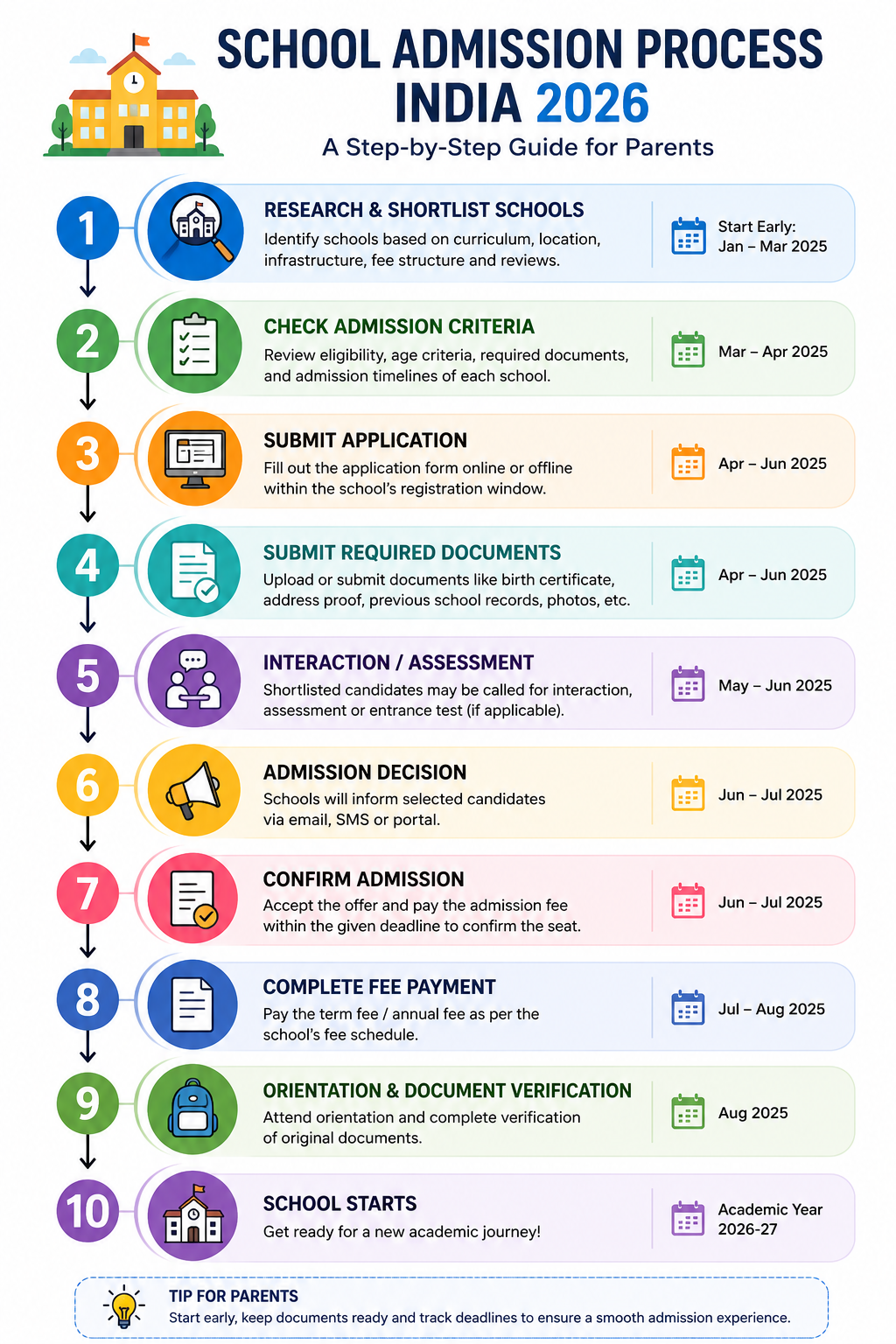
Step 1: Research and Shortlist Schools (Begin: July to September)
Start by identifying 5 to 8 schools that align with your child's learning style, your family's values, and your location. Consider the curriculum (CBSE, IB, IGCSE, State Board), infrastructure, teacher-to-student ratio, co-curricular opportunities, and transport access. Reading parent reviews and attending open days gives you a clearer picture than rankings alone.
Step 2: Check Age Eligibility (Confirm Before You Apply)
Every school and board sets specific age criteria. Applying to a school where your child does not yet meet the age threshold wastes time for everyone. Confirm the cutoff date before you shortlist, not after.
| Grade | Age Requirement (as of 31 March 2026) | Notes |
|---|---|---|
| Nursery / Pre-Primary | 3 to 4 years | Varies slightly by school |
| LKG / KG | 4 to 5 years | Confirm with each school |
| Class 1 | Minimum 6 years | Mandatory across most CBSE schools |
| Classes 2 to 5 | As per previous class completion | Transfer Certificate required |
| Class 6 and above | Based on academic records + assessment | Entrance interaction may apply |
Step 3: Gather Your Documents Early (Start: 2 Months Before Applying)
Missing or incorrect documents are the single most common reason admission processes get delayed. Prepare everything in advance and have at least 5 to 8 photocopies of each document ready.
- Birth certificate of the child (original + copies)
- Aadhaar card of the child and both parents
- Passport-size photographs of the child and parents (at least 6 copies each)
- Proof of residence: electricity bill, gas bill, or rental agreement
- Previous school report card or mark sheet (last 2 years)
- Transfer Certificate (TC) from the previous school, signed by the principal
- Immunisation and health records (required by many schools)
- Category certificate if applying under SC / ST / OBC reservation
- Single parent legal documentation, if applicable
Step 4: Register and Submit the Application Form
Most schools now offer both online and offline application options. Fill in all fields carefully, ensuring that your child's name, date of birth, and parent information match exactly across all documents. Even a minor spelling difference between the birth certificate and the Aadhaar card can cause delays. Keep a screenshot or photocopy of every form you submit.
Pro Tip: Apply to at least 3 to 5 schools simultaneously. The best schools fill up fast, and keeping multiple options open reduces pressure on your family.
Step 5: Attend the School Interaction or Assessment
For nursery and primary admissions, the interaction is almost always informal. Schools typically call parents and children in for a friendly conversation rather than a formal test. Schools are not testing academic brilliance at this stage. They are assessing fit, curiosity, and communication. Prepare your child by staying calm yourself.
Step 6: Review the Admission List and Confirm Your Seat
Most schools publish provisional and final admission lists on their websites between February and March. Once your child's name appears, you will have a short window — usually 7 to 15 days — to confirm the seat by paying the registration or admission fee. Missing this window forfeits the seat.
Step 7: Complete Enrollment and Attend Orientation
After seat confirmation, schools typically ask for original document submission, uniform purchase, book collection, and orientation attendance. Block these dates in your calendar well in advance.
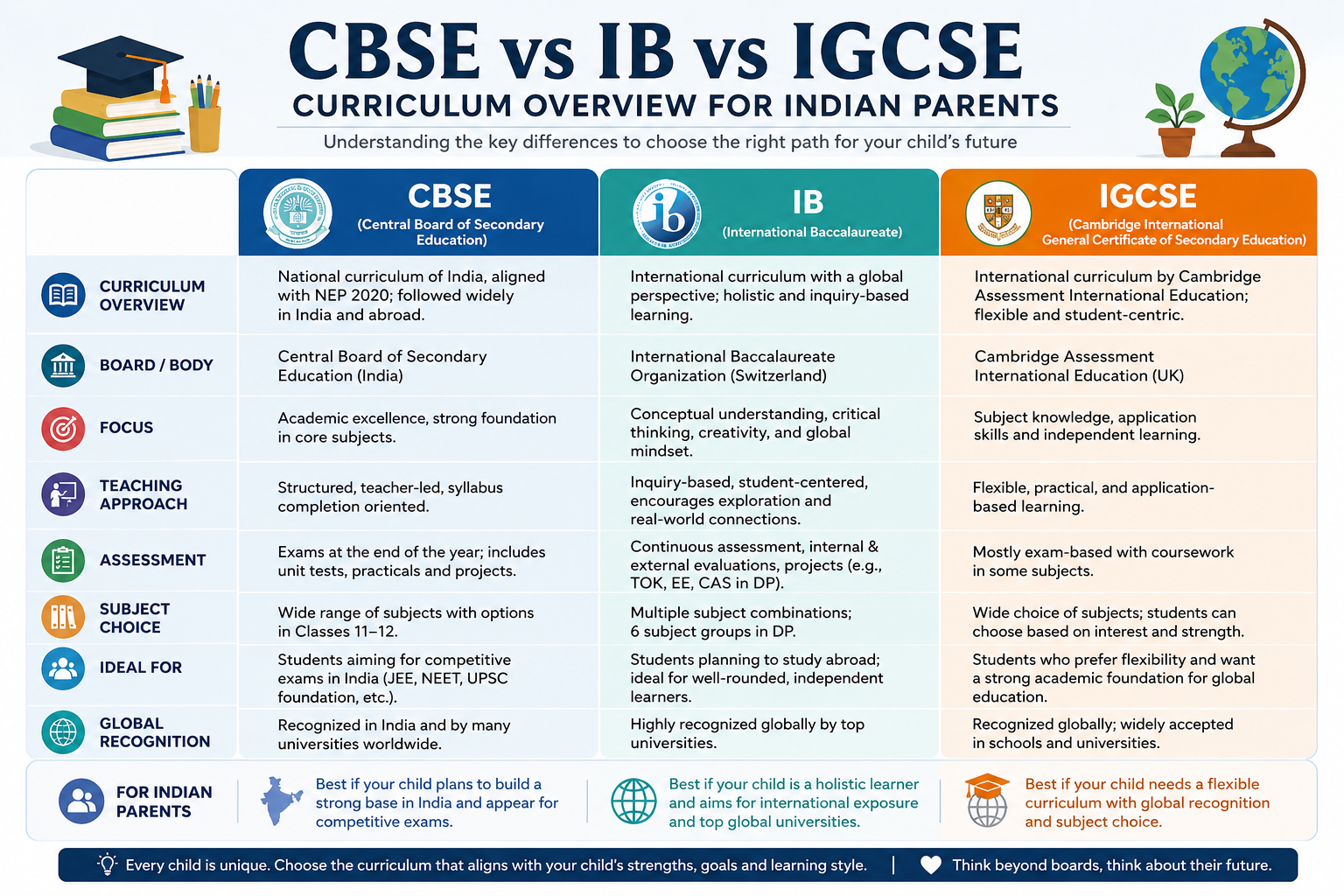
Understanding Curriculum Choices: CBSE, IB, IGCSE, and State Board
One of the most overlooked aspects of school admission is the curriculum decision. Many parents shortlist schools first and consider the curriculum later. Ideally, these two decisions should happen together.
| Curriculum | Best Suited For | Key Strength | Exam Pathway |
|---|---|---|---|
| CBSE | Families who may relocate within India | National uniformity, competitive exam alignment (JEE, NEET) | Class 10 and 12 board exams |
| IB | Families seeking global university admissions | Critical thinking, inquiry-based, globally recognised | IBDP, globally accepted |
| IGCSE / Cambridge | Internationally mobile families | Flexible subject choices, global recognition | IGCSE at Grade 10, A-Levels at Grade 12 |
| State Board | Families committed to the same state long-term | Affordable, locally relevant | State-level board exams |
When to Begin the School Admission Process in India
The most common mistake families make is starting too late. Here is a realistic, month-by-month guide:
| Month | Action |
|---|---|
| July to August | Begin school research, attend open houses, and finalise your curriculum preference |
| September to October | Create a shortlist of 5 to 8 schools, and begin document preparation |
| November to December | Most CBSE schools open registration; submit online enquiries and forms |
| January to February | Attend school interactions and informal assessments |
| February to March | Schools release provisional and final admission lists |
| March to April | Confirm seats, pay fees, and submit original documents |
Common Mistakes Parents Make During School Admissions
Mistake 1: Applying to Only One School
Pinning all your hopes on a single school leaves your child with no backup option if the seat is taken or if you miss the deadline. Apply to at least 3 to 5 schools across your shortlist.
Mistake 2: Ignoring Age Eligibility Before Shortlisting
Parents occasionally shortlist schools based on reputation and only discover later that their child does not meet the age cutoff. A child who misses the cutoff by even a week may need to wait a full academic year.
Mistake 3: Waiting Until the Form Opens to Gather Documents
Transfer Certificates from government schools can take 2 to 4 weeks to be processed. Begin document collection 2 months before you plan to apply, not on the day the form opens.
Mistake 4: Choosing a School Based on Reputation Alone
Rankings and reputation matter, but they do not tell you whether a school's teaching style suits your child, whether the commute is manageable, or whether the co-curricular programme aligns with your child's interests. Visit the campus. Talk to parents whose children already attend.
Mistake 5: Pressuring Children During the Interaction
School interactions for younger children are designed to be informal and friendly. When parents are visibly anxious, children pick up on that energy and perform worse. Prepare your child with light conversation, not coaching sessions.
The Bottom Line on School Admissions
The right school admission starts with the right information. When you understand the process, prepare your documents, and start early, you move from stress to confidence — and your child starts their school journey on the right foot.
School admissions in India are structured, fair, and manageable once you know the steps. The key is to begin early, stay organised, apply to multiple schools, and make your curriculum decision alongside your school selection.
Manchester Global School is here to support you through every stage of this process. From understanding which curriculum suits your child to navigating our admissions process, our team is happy to answer your questions.
Frequently Asked Questions
Final Word: Manchester Global School is here to support you at every step. Visit our admissions page or schedule a campus tour to begin your journey with us.