Why Mental Maths Matters: Benefits and Applications

Research says humans are born with an innate ability to count and measure the quantities which are fundamental in mathematical concepts. As a result, mathematics is one of the first few disciplines that was developed in improving human standards over the centuries. Development in Mathematics has led to various developments in trade, science, engineering, technology, arts, and humanities as well. This is the reason, mathematics is considered as a bridge between all the disciplines / Mathematics is called the queen of all sciences and the slave of all the disciplines.
What is Mental Maths?
Mental mathematics, also known as mental maths or arithmetic, is the ability to perform arithmetic and mathematical problems without using any tool, or device like calculators, pens, or even paper. It refers to cognitive abilities for calculation, reasoning in mathematics, and problem solving in one's head. Mental mathematics encompasses various skills, including the recall of arithmetic facts, and the ways of doing mental mathematics. Effective mental mathematicians solve problems quickly using a variety of approach including images, numbers, rough estimates, and a restricted number of operations. For the individual, the benefit would be to focus on further developing skills similar to concepts in mathematics and mastering the more complicated areas of it.
Most of the day to day calculations done by adults are mental arithmetic. Hence, it is necessary for all of us to develop the number sense and mental arithmetic skills. Moreover, it's a proven fact from various studies that mental mathematics provides the following benefits.
Benefits of Mental Maths
- Improved focus and concentration
- Enhanced critical thinking and problem-solving skills
- Better retention skills
- Increased creativity in solving real-life problems
- Speed and accuracy in financial management
Some Mental Maths Tricks and Applications
The following section provides easier ways to add, subtract and multiply integers
Addition & Subtraction (Left-to-Right Method)
Sometimes addition requires students to carry a number which may trick them. However, using the method of adding from left to right makes things easy. Let's say we need to add 57 and 74. We know that 74 can be written as 70 + 4. Hence to solve 57 + 74, first we can add 57 and 70, which is 127 then add 4 results in 131.
Similarly addition of 78 and 56 can be performed in the following way.
Example 1: 78 + 56 = 128 + 6 = 134
( add 534 and 400) ( add 934 and 70)
One more example of adding 1452 and 475 is explained here
Example 2: 1452 + 475 = 1852 + 75 = 1922 + 5 = 1927
(+ 400) (+70) (+ 5)
We can adopt and modify the above method for subtraction of numbers as well. The following example can be used for subtraction. Example: 1748 - 856
Example 3: 1748 - 856 = 948 - 56 = 898 - 6 = 892
(1748 - 800) (948 - 50)
Multiplication
Calculations related to multiplication require students to remember products of each digit with another digit, as shown in the following table.
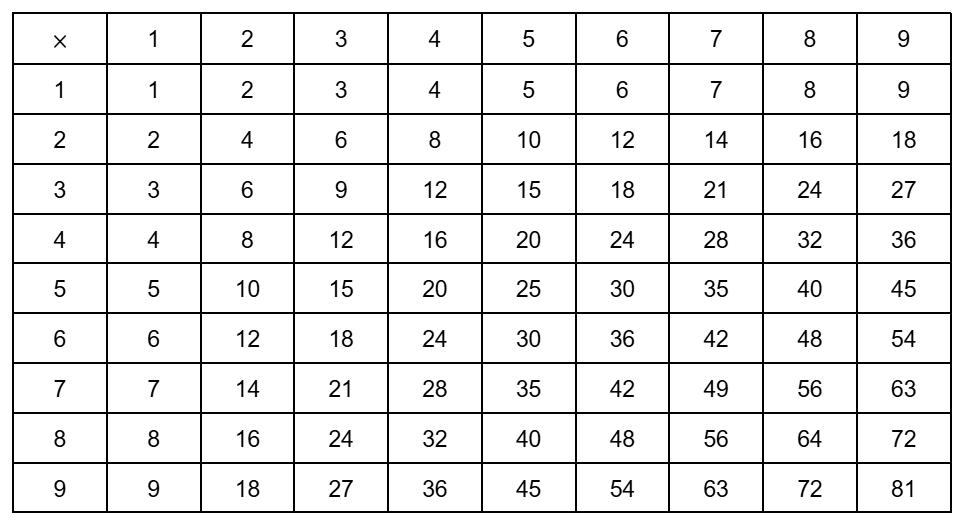
Example1: 63 x 38
Method1:
Here 38 can be written as 30 + 8. Hence the multiplication can be written as 63 (30 + 8). Hence we can use distributive properties of multiplication to calculate this product in an easier way.
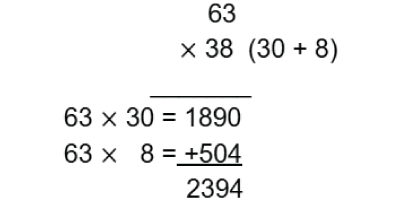
The same multiplication can be done in a slightly different manner as well which is explained below.
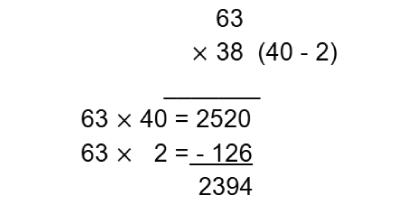
Method 2 :
The multiplication of the same numbers using the second method can be explained in the following steps
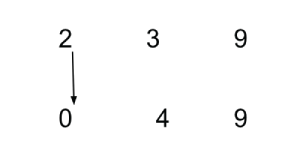
Step 1: Finding the unit digit of the product. To find the unit digit of the product, we must multiply the unit digit of the given two numbers. 3 x 8 = 24. Hence 4 is the unit digit of the product and 2 will be carried over to the next step.
Step 2: Finding 10s digit: To find the tens digit, we must cross multiply as shown below.
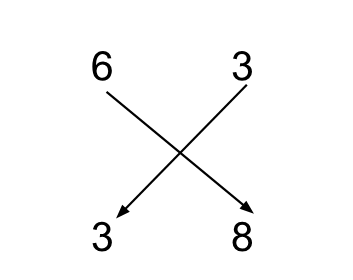 Using the 2 from step 1, we can calculator 10 digit as follows 2 + (6 x 8) + (3 x 3) = 59. Hence 10's digit is 9 and 5 will be carried over to the next step
Step 3: Finding 100's or 100's and 1000's digits. Here we multiply both 10's digits of each number and add 5 from the previous step 2 x 5+(6 x 3) = 23.
Hence final answer product is 2394 The second method is useful in multiplying large numbers in an easier manner. An example is given below for your reference.
Example 2: 239 X 49
Step 1: Units digit = 9 X 9 = 81
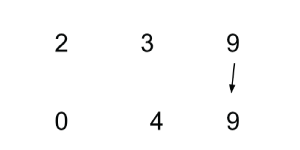
Step 2: Step 2: 10's digit = 8+ (39) + (49) = 71
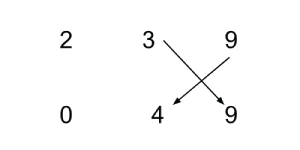
Step 3: 100's digit = 7 + (2x9) + (0x9) + (3x4) = 3 7
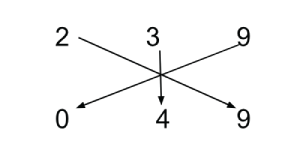
Step 4: 1000's digit = 3+ (2x4) + (3x0) = 1 1

Step 5: 10,000's digit = 1 + (2x0) = 1
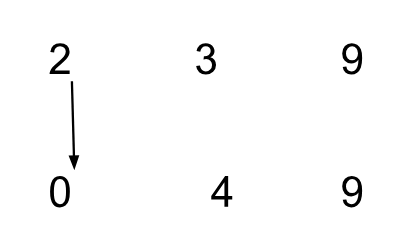
Therefore the final product is 11711
Multiplication with 11:
There is an interesting trick we can use for multiplying two digit numbers with 11. For example 35 11. Add 3 and 5, then place this sum between 3 and 5. Hence the product is 385.
Another example. 45 11 = 495 because 4+5 = 9.
In case if the sum of the digits is more than 9, you can carry the 10's digit of the sum to the number on the left side. For example 58 11: We know 5+8 = 13. Hence 1 will be added to 5. Then the product is 638.
You can try the following exercise to practise the above tricks.
References Benjamin, Arthur, and Michael Shermer. Secrets of Mental Math the Mathemagician's Secrets of Lightning Calculation & Mental Math Tricks. Paw Prints, 2008.